Just a few steps from the crowds of Piazza del Duomo, there is a corner of Milan where the city suddenly seems to travel back in time.
Walk through one of the narrow passages leading into Piazza Mercanti and the atmosphere changes completely. Stone arches, medieval façades and ancient symbols surround a square that was once at the heart of Milan's political, judicial and commercial life.
Many visitors walk past it without even noticing it.
But Piazza Mercanti hides some of Milan's most fascinating stories: a mysterious half-woolly pig linked to the legendary origins of the city, a medieval punishment for dishonest debtors, an ancient public well and a remarkable acoustic secret that you can still experience today.
The heart of medieval Milan
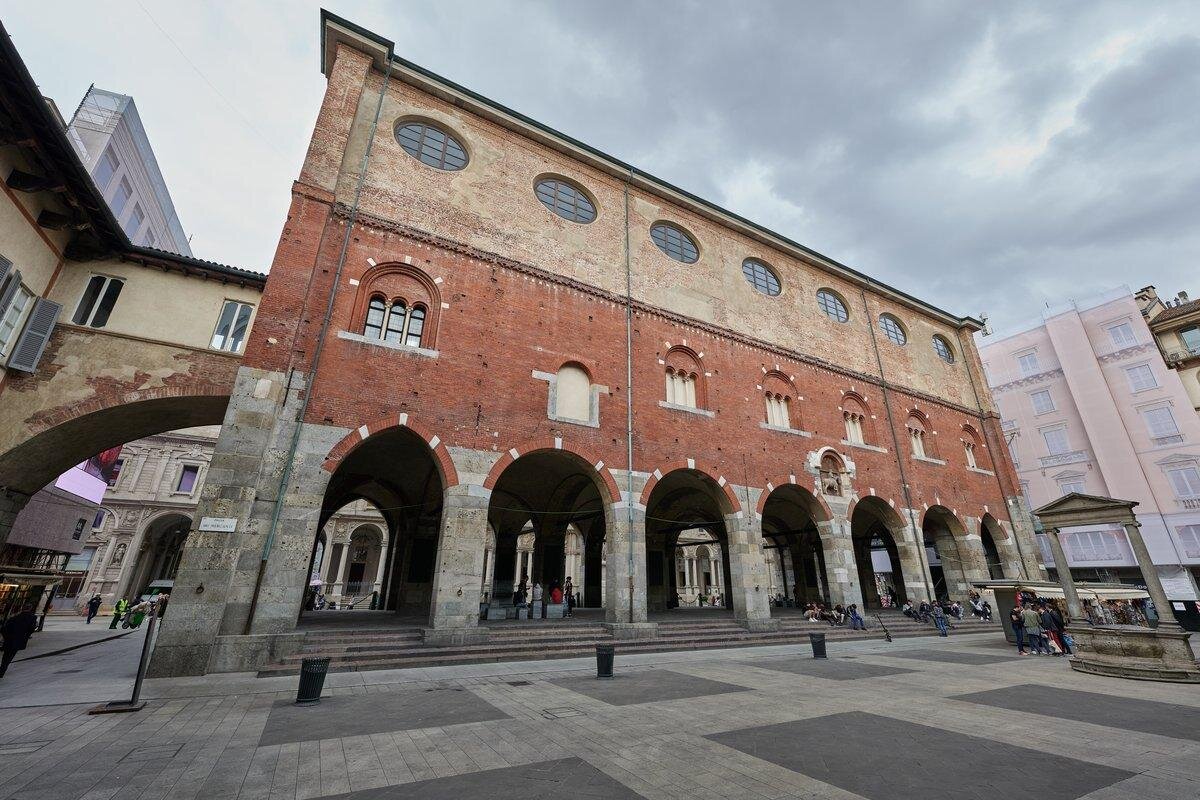
Piazza Mercanti developed around Milan's medieval Broletto, the centre of civic and administrative life.
Its most important building, the Palazzo della Ragione, was begun in 1228 and completed in 1233. For centuries it performed administrative and judicial functions and later became closely connected with the commercial life of the city.
Today, modern Milan surrounds the square on every side. The Duomo, Via Dante and some of the busiest streets in the historic centre are only steps away.
Yet entering Piazza Mercanti still feels like discovering a small fragment of another city.
And one of Milan's oldest and strangest symbols is waiting beneath its arches.
Did a half-woolly pig really give Milan its name?
Look carefully at the arches beneath Palazzo della Ragione.
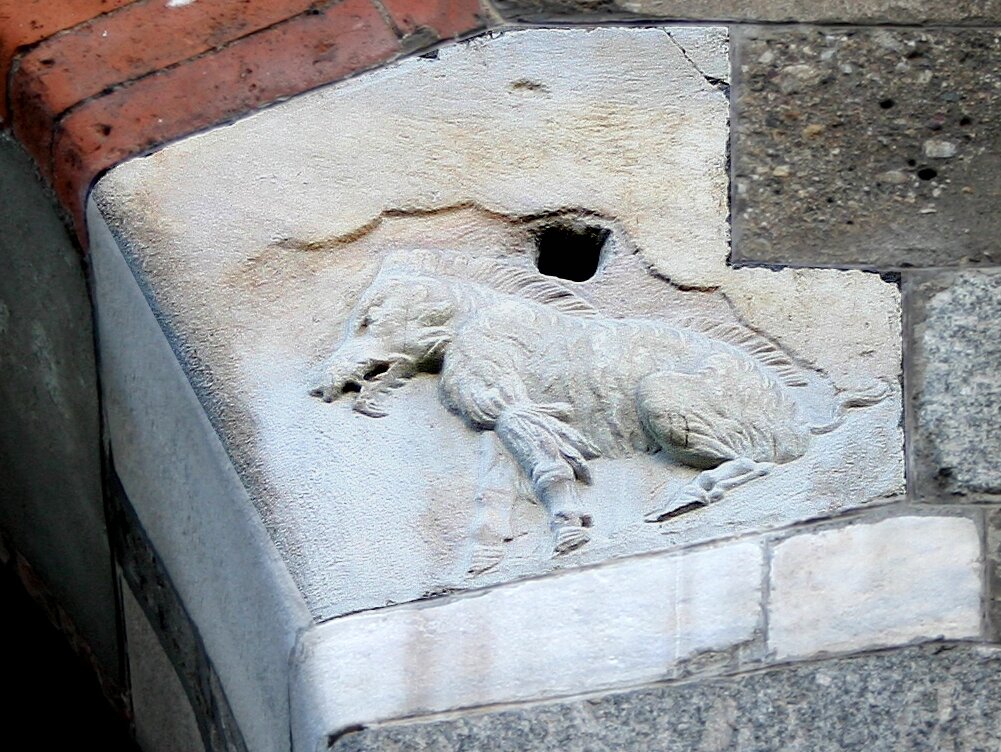
On the pillar of the second arch you will find an ancient stone relief depicting the Scrofa Semilanuta — literally, the “half-woolly sow”.
The relief was discovered during the construction of Palazzo della Ragione in the 13th century and incorporated into the building. The animal was an ancient symbol of Milan, with origins stretching back long before the symbols most visitors associate with the city today.
And this is where history meets legend.
According to the traditional story of Milan's foundation, the Celtic leader Belloveso arrived in northern Italy in search of a place to establish a new settlement. The place was supposedly revealed by the appearance of an extraordinary animal: a sow covered with wool on only half of its body.
The settlement founded there would eventually become Milan.
Over the centuries, popular tradition even connected the animal with the Roman name of the city, Mediolanum, interpreting it through expressions such as medio lanae or “half-woolly”.
It is a wonderful story — but it should be treated as legend rather than established etymology.
What is certain is that the scrofa became deeply embedded in Milanese identity and left traces that can still be discovered around the historic centre.
Can you find the other pigs?
Once you have spotted the ancient scrofa beneath Palazzo della Ragione, don't stop looking. The half-woolly sow appears elsewhere in Milanese architecture.
Nearby, the Palazzo dei Giureconsulti contains another representation of the animal in a relief depicting Orpheus together with the scrofa semilanuta.
Other representations of this ancient Milanese symbol survive elsewhere in the historic centre, turning the story into a small urban treasure hunt.
So when you walk through central Milan, remember to occasionally look above eye level.
You may discover that the city's history is hiding in the stonework.
Now try Milan's medieval “telephone”
Before leaving Palazzo della Ragione, there is something you should actually try.
Stand beneath its portico and ask another person to move to the opposite corner of the vaulted space.
Face the wall and speak softly.
The particular acoustics of the vaults carry your voice along the structure, allowing the person at the opposite corner to hear you with surprising clarity.
It really works.
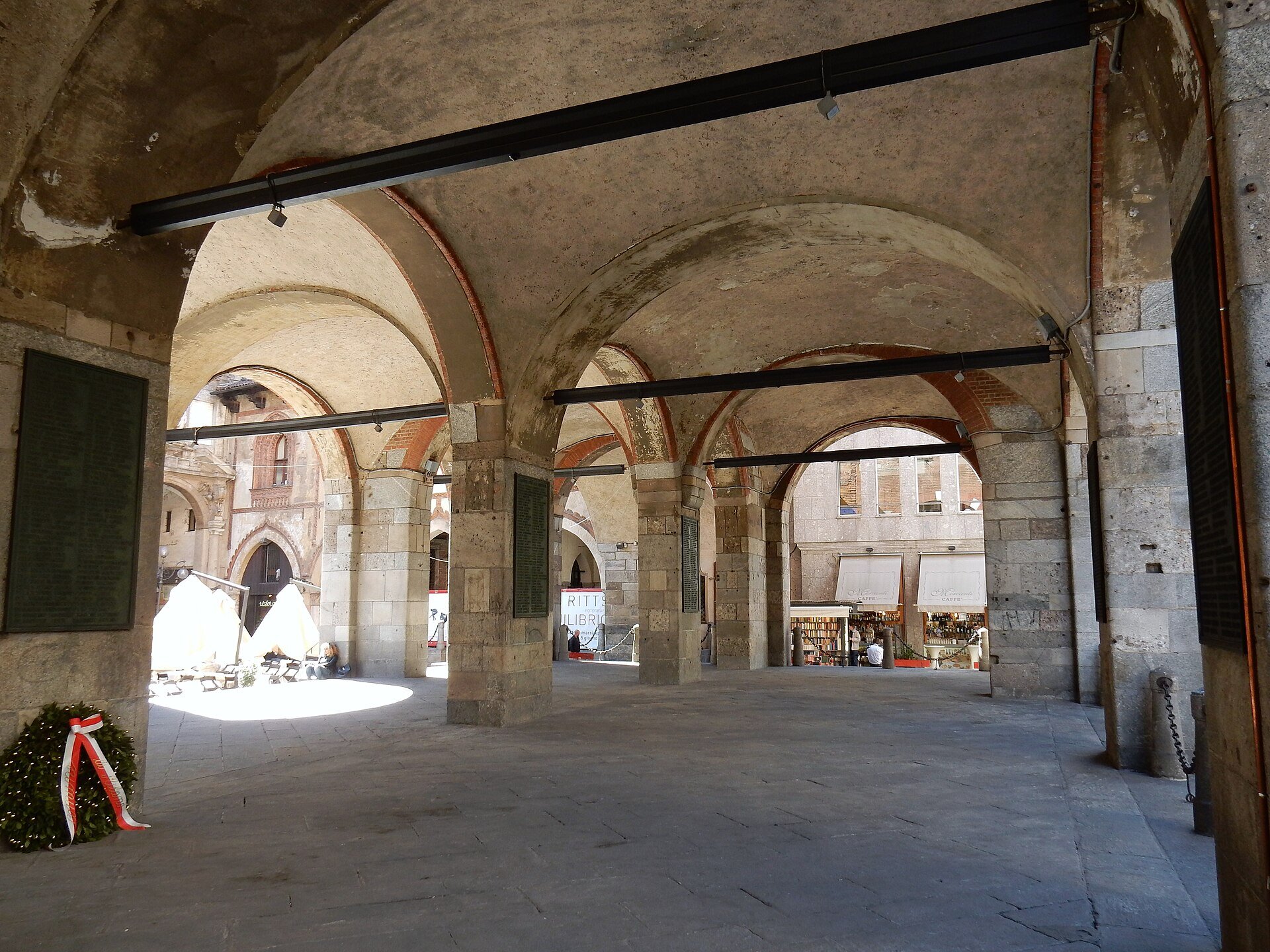
The phenomenon is sometimes described as Piazza Mercanti's “whispering gallery” — almost a medieval telephone hidden beneath the arches.
And inevitably, Milan has a story to explain it.
According to a popular tradition, the unusual acoustics were also used during outbreaks of plague, allowing people to communicate — and according to some versions even confess — while keeping their distance from one another.
Whether this was genuinely how the portico was used during epidemics is much harder to establish historically.
The acoustic phenomenon itself, however, is very real.
So don't just read about it.
Try it yourself.
The Stone of the Bankrupts
Before the well occupied its present position, this area was associated with the infamous Pietra dei Falliti — the Stone of the Bankrupts.
In medieval Milan, people who committed fraud or became insolvent could face a deliberately humiliating public punishment. Those awaiting judgment could be forced to sit on the stone with their bare backside exposed, turning financial disgrace into a very public spectacle.
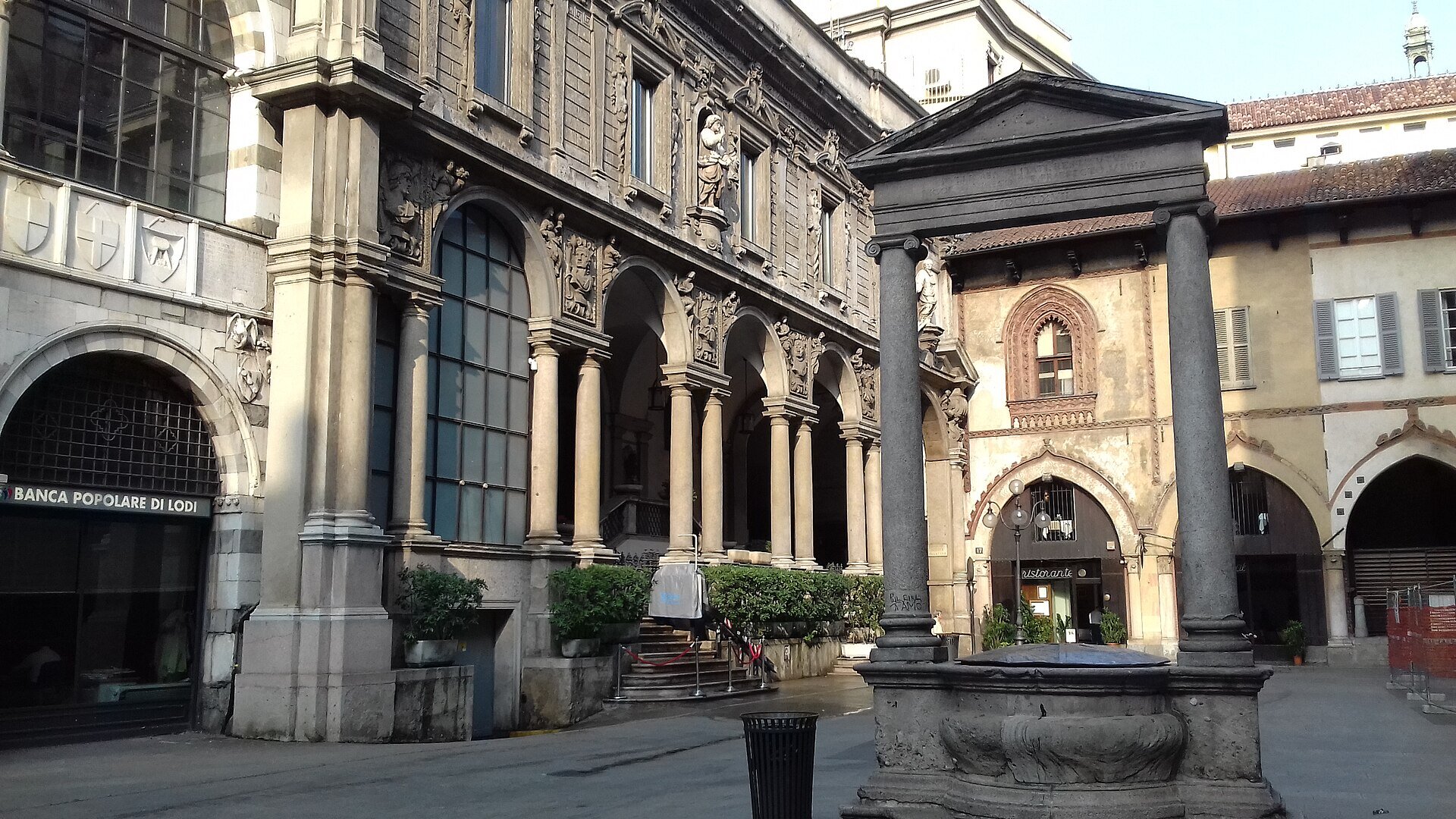
It is difficult to imagine today, surrounded by tourists taking photographs only a few metres from the Duomo.
But it is another reminder that Piazza Mercanti was not created as a picturesque historical backdrop.
This was a place where real civic life happened: business was conducted, judgments were pronounced, public announcements were made and punishments were carried out.
More than a shortcut from the Duomo
Piazza Mercanti is easy to miss and, perhaps, that is precisely what makes it special.
Within a few minutes you can stand beneath a building completed in the 13th century, search for the legendary animal connected with Milan's origins, test an extraordinary acoustic phenomenon and discover traces of the city's medieval justice system.
You don't need a ticket.
You don't need to plan an entire afternoon.
You simply need to know where to look.
So next time you visit the Duomo, don't immediately follow the crowds to the next famous attraction.
Take a few steps into Piazza Mercanti.
Look up. Look for the scrofa. Whisper into the arches. And discover another Milan.